
Cass County Parole and Probation
Michigan parole follows a state-prison term. The Michigan Parole Board is the sole paroling authority for felony offenders committed to the Michigan Department of Corrections. When a prisoner is physically released on parole, OTIS may change the status from “Prisoner” to “Parolee.” The person is back in the community but remains under MDOC jurisdiction. Michigan says parole supervision ordinarily lasts from one to four years, though the controlling order and sentence record govern an individual case.
Felony probation comes from a sentencing court. It may begin without an MDOC prison term, or it may follow some jail time. An OTIS “Probationer” status therefore proves supervision, not a prior prison release. A Cass County Jail release log answers when county custody ended, while OTIS and the field office answer state supervision questions. These records should not be merged into one event.
| Point | Parole | Probation |
|---|---|---|
| Starting point | Release from an MDOC prison term | Sentence imposed by a court |
| Public status source | OTIS parolee record | OTIS felony probation record when published |
| Local contact | Cass County Parole/Probation Office | Cass County Parole/Probation Office for MDOC felony probation |
| Completion | Discharge from MDOC supervision | Discharge from the probation term |
A few terms keep the record clear:
- Parole
- Conditional community supervision after physical release from state prison.
- Probation
- A court-ordered community sentence that does not by itself prove a prison stay.
- Discharge
- The end of the identified supervision term or MDOC sentence jurisdiction.
- Absconder
- A person reported as out of compliant contact with supervision, not successfully discharged.
Verify Cass County Post-Release Supervision
The official person-level starting point is the MDOC OTIS landing page and its direct offender search. Michigan does not publish a second, general parole-supervision name search. OTIS includes current prisoners, parolees, felony probationers, and people discharged from MDOC supervision during the prior three years. It excludes jail-only sentences and people who have been off MDOC supervision beyond that public window.
Use the following sequence to avoid confusing a same-name record or a county release with state supervision:
- Search the six-digit MDOC number when known. Otherwise use the person’s first and last name and narrow the results with available identifiers.
- Open the matching record and compare the MDOC number, aliases, physical description, and offense entries. Do not rely on name alone.
- Read the exact status. “Parolee,” “Probationer,” “Prisoner,” “Absconder,” and “Discharged” have distinct meanings.
- Check the listed supervision location. A Cass assignment can point to the Region 8 Cassopolis office, while a prison record may name another facility.
- Contact the listed field office when the public status or reporting location needs clarification. Ask a state-supervision question, not for a Cass County Jail release log.
- For documentary proof of final state discharge, request the relevant MDOC record. OTIS is a public status tool, not a certified discharge certificate.
The official OTIS offender search shows the interface used for this check.
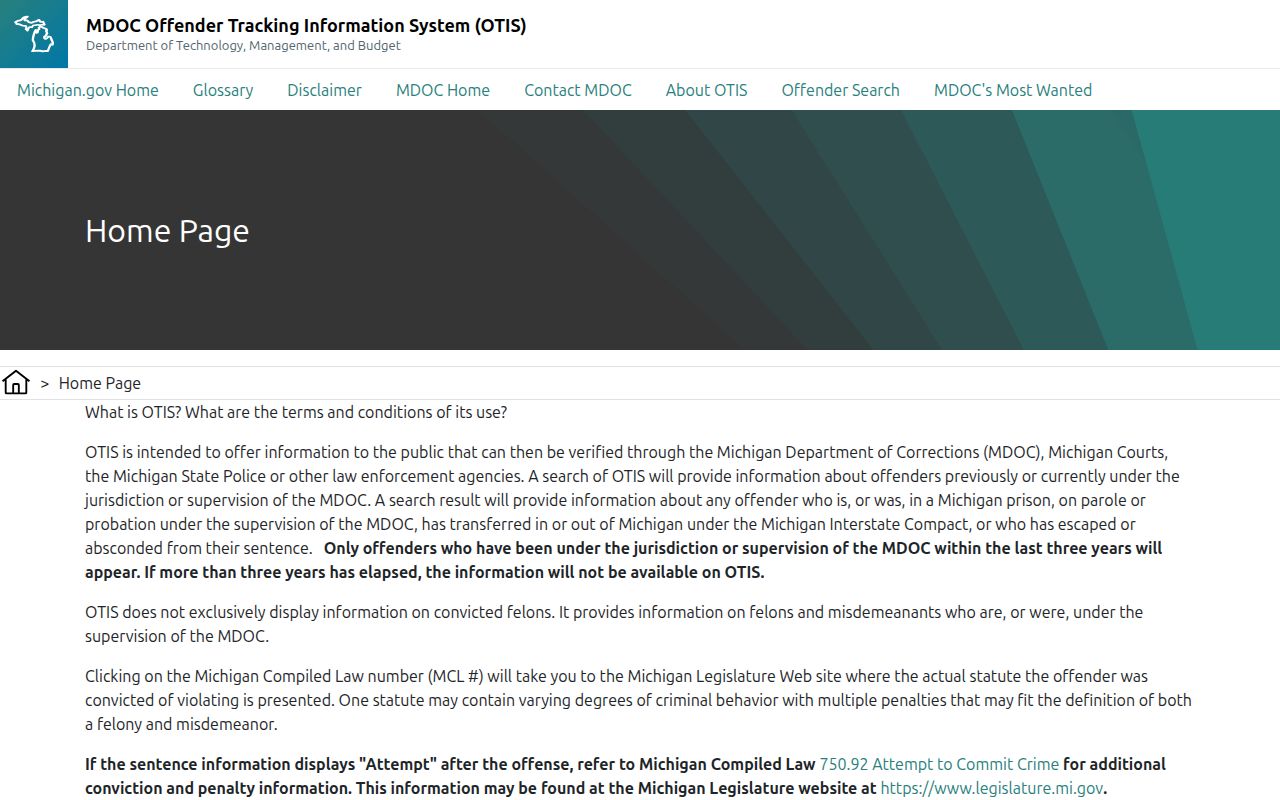
The search must be read with its scope in mind: a Cass jail-only case will not appear merely because the arrest occurred in Cass County.
Note: OTIS retains a discharged profile for three years after MDOC supervision ends, not three years after prison release.
Cass County Parole Path from Jackson
A distinctive Cass County parole path can begin outside the county. Cooper Street Correctional Facility is in Jackson, not Cass. MDOC identifies it as an In-Reach and release facility for P-70 parolees returning to Region 8, which includes Cass County. A person may therefore leave state prison through Cooper Street and later report to a supervision office in Cassopolis.
This two-place route explains why the physical departure record and the local reporting contact may name different places. Cooper Street or MDOC records can support the prison-release event. The Cass County Parole/Probation Office can clarify the local state-supervision channel. The Cass Sheriff does not hold the state-prison parole record, and the field office does not hold the county jail’s door-out timestamp.
A parole grant also does not mean the person has already left prison. The MDOC parole consideration process describes a proposed date and release planning after a grant. MDOC says at least 28 days ordinarily separates the decision from physical release, and placement work, a detainer, misconduct, or new adverse information can affect the plan.
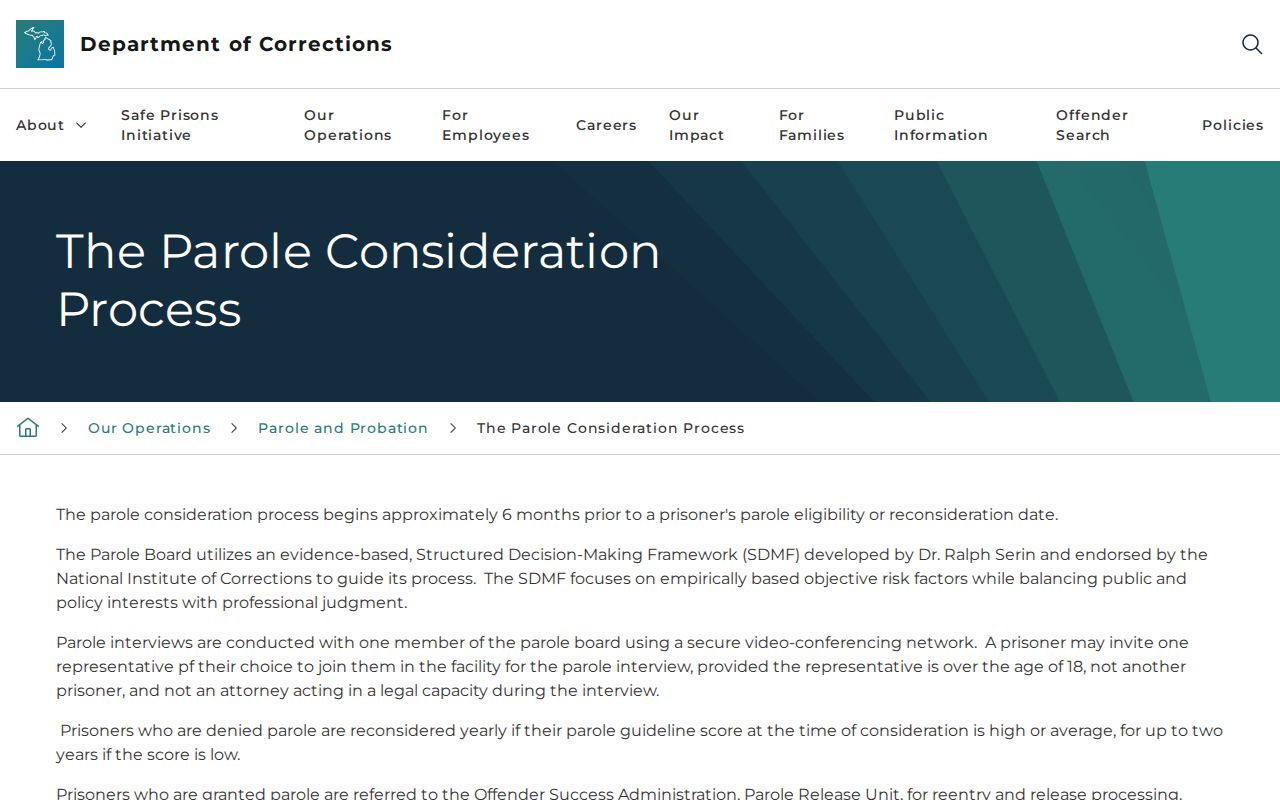
The practical sequence is eligibility, Board action, a proposed date, actual prison departure, community supervision, and final discharge.
Cass County Supervision Office Details
Cass County has one combined MDOC Parole/Probation office in the county administrative building. It serves Region 8 state-supervision matters. The office can help route an appropriate question about an OTIS supervision location, parole reporting, or felony probation. It is not a jail, and it cannot replace the Sheriff’s release-log process.
Cass County Parole/Probation Office
120 N. Broadway St., Suite 215
Cassopolis, MI 49031
269-445-4404
The MDOC Region 8 office directory is the source for this Cassopolis contact.
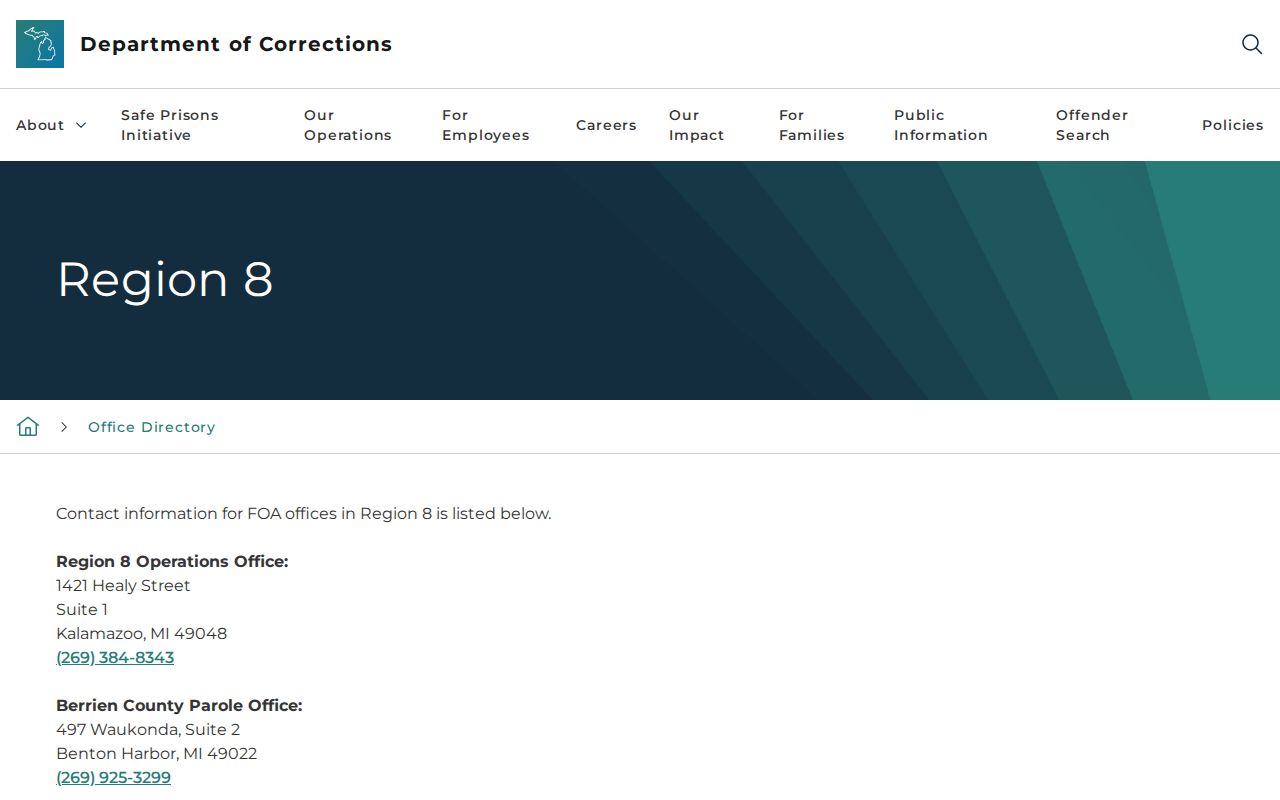
Check the current OTIS assignment before assuming this office supervises a specific person, since assignment and status can change.
Cass County Absconder Status
An OTIS “Absconder” label is the opposite of successful discharge. It signals that the person is reported as out of compliant contact with supervision. The label may be linked to enforcement activity, but it should not be expanded into an unsupported claim that a specific warrant, charge, or conviction exists. OTIS remains the individual-status channel.
MDOC lists an Absconder/Escapee Tip Line at 517-755-0855. Its legislative reports archive also carries quarterly aggregate parole-absconder reports. Those reports describe totals and trends. They cannot verify one Cass County person’s present status, office, warrant, or case.
VINE notifications serve a different role. MI-VINE may report custody events such as release, transfer, or escape from a participating provider. A supervision absconder status and a jail escape event are not interchangeable. Preserve the precise event label, reporting agency, and observation date when reconciling records.
Note: A missing OTIS result can reflect the three-year display limit and must not be relabeled as discharge or absconding.
Cass County Parole Conditions
Community supervision carries conditions set through the governing parole or probation process. The exact terms belong to the individual order and supervising record, not to a generic checklist. At a high level, supervision can require reporting, an approved residence, compliance with travel limits, payment or program duties ordered in the case, and lawful conduct. A parolee remains under MDOC jurisdiction. A felony probationer remains subject to the sentencing court and the assigned supervision framework.
A suspected violation is not the same as a final finding. The record may move through reporting, investigation, a warrant or custody event, a hearing, and a Board or court response. Parole revocation can return a person to prison after release. Probation action follows its own court process. For that reason, an OTIS status should be paired with the current court or MDOC record before describing what happened.
When a person appears in custody again, identify the new reporting agency. MI-VINE can supply a jail or MDOC custody event, while OTIS supplies the state corrections category. The Cass County field office may route a proper supervision question, but it does not disclose or interpret every case detail by phone.
Cass County Parole Board Records
Parole consideration generally begins about six months before eligibility. Most decisions use three-member panels, while life-sentence matters can involve broader statutory procedures. The Board may grant parole, deny it, or defer action for more facts. A grant starts release planning. A denial supplies reasons and a later review point. A deferral means more information or action is needed.
Michigan does not offer a general public name-searchable database of individual Parole Board decisions. Ordinary parole interviews also do not all appear on one master public calendar. The Public Hearing Registration page chiefly covers specified parole-eligible lifer, pardon, and commutation hearings. Event notices are posted about two weeks to 30 days before those hearings. Absence from that page does not prove that no ordinary review is pending.
For one person, the sound chain is OTIS, the applicable decision or action notice when lawfully available, and MDOC records. Quarterly aggregate reports do not replace that chain. MCL 791.234 addresses eligibility and Board jurisdiction; eligibility does not create a right to release. MCL 791.233 supplies the parole standard, while MCL 791.244 governs specified public-hearing procedures.
Ending Cass County Supervision
Parole can end through successful discharge, maximum discharge, or another formal MDOC action. Probation ends through the court and supervising system that imposed and administered that term. A prison departure to parole is not final discharge. OTIS may continue to show the person as a parolee until MDOC jurisdiction ends, after which a discharged profile can remain public for three years.
Violations can interrupt the expected path. After release, the Parole Board may revoke parole and return a person to prison. A proposed release can also be suspended before departure because of later misconduct, new adverse information, placement issues, or a detainer. Each stage needs its own record: the Board action for the decision, OTIS for current public status, and a Discharge Certificate or responsive MDOC record when formal proof of completion is needed.
For a county-jail event with no MDOC term, use the Cass County released-inmate search and records path. It separates the Sheriff’s release log from OTIS supervision data. The difference matters because leaving the Cass County Jail, leaving state prison on parole, and ending state supervision can occur on three different dates.