
Cass County Projected vs Actual Release
“Projected release date” is a broad search phrase, not the name of one Cass County field. For an MDOC prisoner, Michigan uses Earliest Release Date and Maximum Discharge Date. ERD marks the point when the minimum has been served and the Parole Board gains jurisdiction, after any credits that lawfully apply to an older sentence. It is an eligibility landmark. Maximum Discharge Date is the potential endpoint of the maximum term.
A county-jail date follows the Cass court judgment, jail timekeeping, any lawful county good-behavior allowance, and other holds. A pretrial detainee has no sentence-completion date. Bond or a court order may authorize release, but the Cass County Jail supplies the physical release entry. Federal BOP dates belong to the federal system and should not be treated as Cass jail or MDOC dates.
Scheduled versus actual: An ERD, Board grant, court order, or proposed date does not prove that a person passed through the release door.
The actual event appears later in the release log, OTIS parole or discharge data, VINE event, or another originating agency record.
Find a Cass County Release Date
Start with the last known custodian. Cass County Jail does not publish a sentence-date calculator or a public recent-release roster. OTIS does not cover jail-only terms. Choosing the wrong portal can produce a clean search result that says nothing about the person’s real custody path.
- For a Cass jail detainee, determine whether the case is pretrial or sentenced. Review the correct 4th District or 43rd Circuit case for bond, judgment, jail credit, dismissal, or commitment terms.
- Call Cass County Jail at 269-445-1209 for appropriate routing when a sentence completion or current release process needs clarification.
- Request the Sheriff’s release-log or timekeeping record when exact release date, time, disposition, or destination is needed. A narrow booking and date range reduces same-name errors.
- For an MDOC prisoner, search OTIS by the six-digit MDOC number when available and check each sentence entry.
- Read ERD and Maximum Discharge Date as landmarks. Then look for parole status, date paroled, or discharge data to identify a later actual event.
- When the record points to federal custody, use the BOP locator and federal records. Use ICE ODLS only when a supported immigration transfer exists.
The Cass County release search and records process supplies the full county verification chain when the question is about a completed jail release rather than a future date.
Note: A negative OTIS search cannot resolve a jail-only sentence because county detainees are outside the database’s stated scope.
Cass County OTIS Release Landmarks
OTIS covers current prisoners, parolees, probationers, and people discharged from MDOC supervision in the prior three years. Search by MDOC number when possible, confirm identity, and open every sentence entry. Concurrent and consecutive terms can produce several displayed dates, so the controlling sentence structure matters. A user should not select the earliest visible number without reading the linked offenses and status.
| OTIS field or status | What it supports | What it does not prove |
|---|---|---|
| Earliest Release Date | Minimum-term eligibility landmark | Parole grant or physical release |
| Maximum Discharge Date | Potential endpoint of the maximum term | That custody will end on that date in all systems |
| Prisoner | Current MDOC prisoner category | A future door-out date |
| Parolee / date paroled | State-prison departure into supervision | Final discharge from the sentence |
| Discharged | MDOC supervision ended within the display window | A complete county or federal custody history |
If an OTIS fact appears wrong, MDOC directs factual correction questions to correctionsinfo@michigan.gov. Supervision-related errors can be taken to the listed field office. Capture the current status and observation date because a live record can change as release processing advances.
Cass County Truth in Sentencing
Michigan is not governed by a general “serve 85%” rule. Under Michigan Truth in Sentencing, covered state prisoners serve 100% of the judicial minimum in prison before parole consideration. MDOC says the rule applies to specified assaultive crimes committed on or after December 15, 1998, and all other crimes committed on or after December 15, 2000. Covered prisoners do not shorten that minimum with good-time or disciplinary credits.
The official MDOC Truth in Sentencing explanation sets out this Michigan framework.
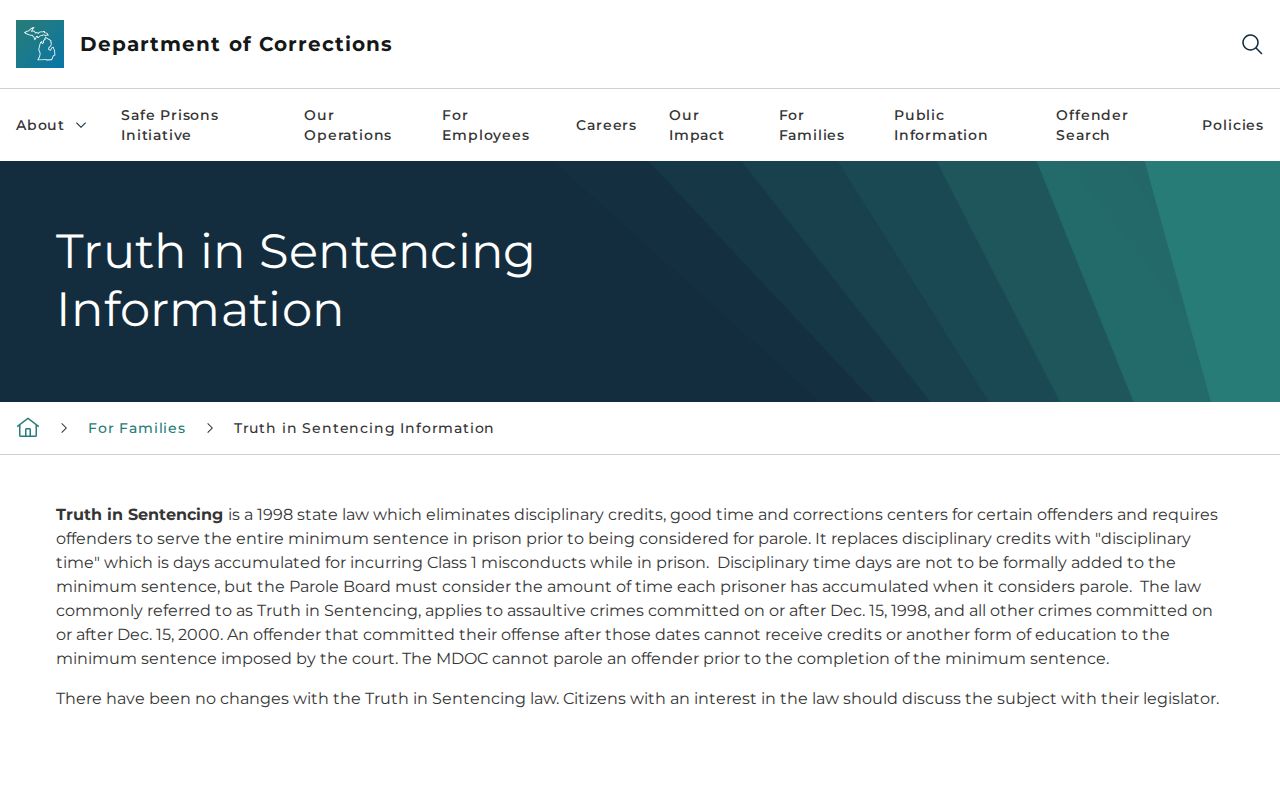
The date inquiry must begin with the offense date, offense type, judgment, and sentence structure. A fixed percentage borrowed from another system will misstate Michigan law.
MCL 791.234 is the main Board eligibility and jurisdiction statute. Reaching the statutory point gives the Board authority to act in an eligible case; it does not require a grant. MCL 791.233 addresses the parole standard and conditions. The judgment and MDOC computation remain essential because court credit and consecutive terms can change how the displayed landmarks are reached.
Cass County Jail Good-Time Rule
State-prison rules and Cass County Jail rules must stay separate. MCL 51.282 gives an eligible county-jail prisoner one day of good-behavior allowance for each six days of sentence when the record shows no rule violation. The Sheriff may forfeit or restore the allowance under the statute. This does not create an OTIS ERD, and Cass does not publish a public projected-date feed for jail sentences.
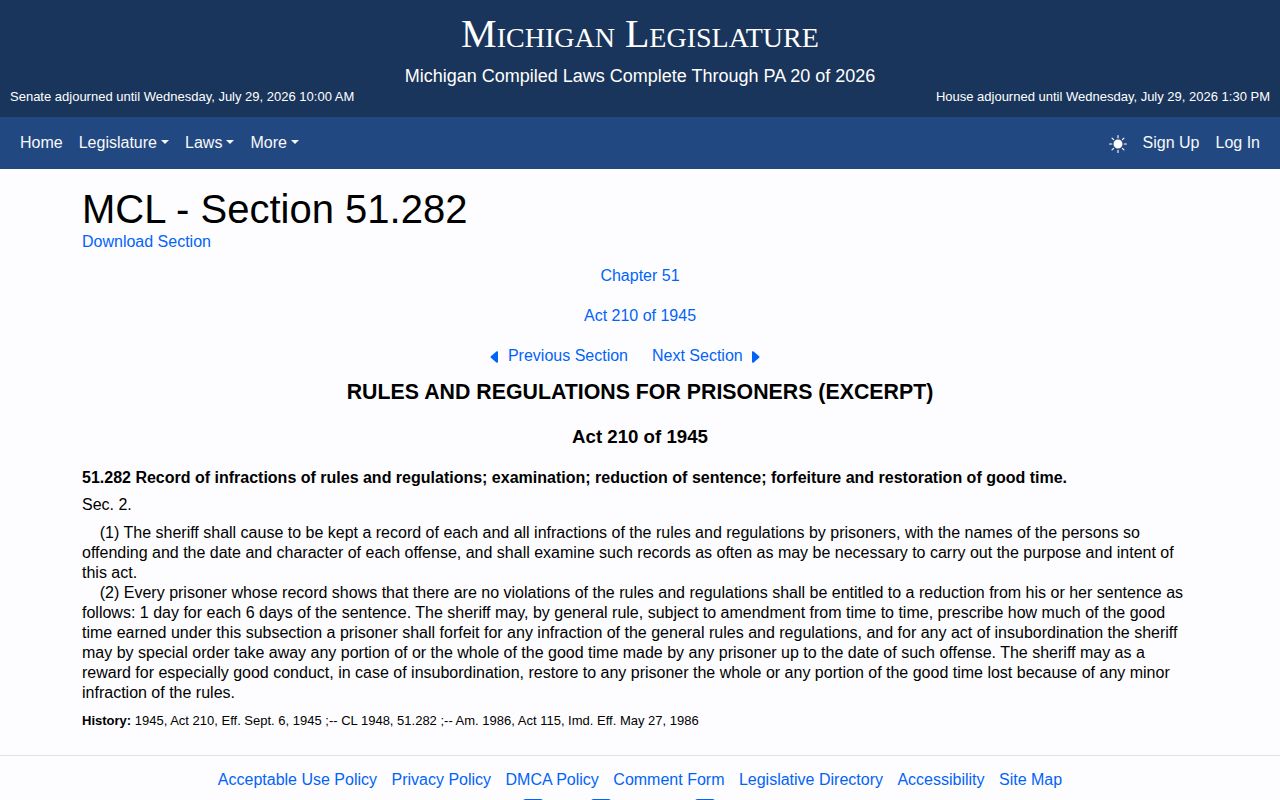
The statute supports the rule, while the judgment and jail’s own timekeeping record support the individual calculation.
Older MDOC sentences can use other credit systems. For eligible crimes committed on or after April 1, 1987, but before the relevant Truth in Sentencing cutoff, MDOC describes disciplinary credits generally as five days per month, with up to two extra days for exceptionally good behavior and a stated cap of 84 days per year. Misconduct can cause loss. Still earlier eligible sentences may involve good time under MCL 800.33.
The MCL 800.33 credit provisions are one source for the older framework.
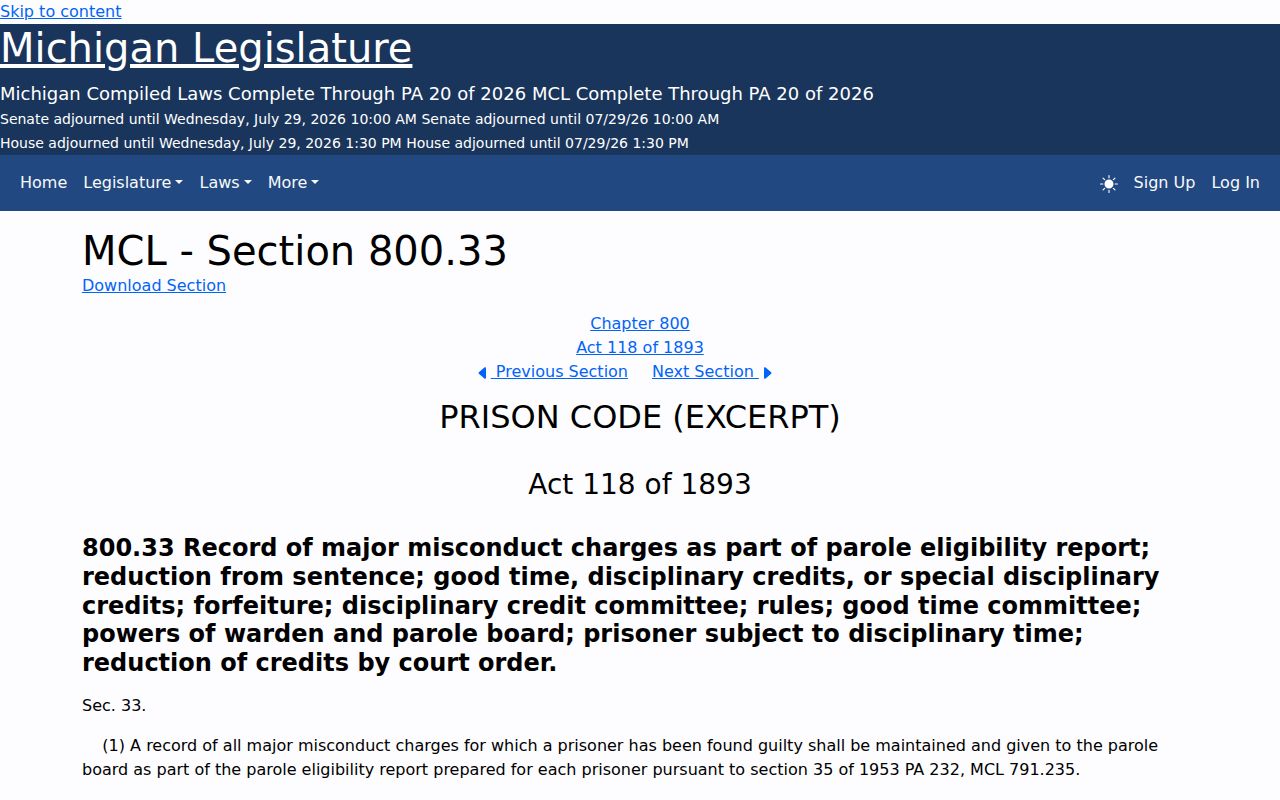
Offense date and legal eligibility decide whether those rules apply. They must not be added to a covered modern sentence.
Why Cass County Release Dates Change
A displayed date can move, or it can arrive without becoming a release date. Some changes correct the calculation. Others block or alter the planned departure. The source of the change determines which record should be checked.
| Factor | Possible effect | Best record |
|---|---|---|
| Corrected court document | Changes sentence or credit inputs | Judgment and amended court order |
| Concurrent or consecutive terms | Changes which sentence controls | Judgment plus OTIS sentence entries |
| Legacy credit loss | Moves an eligible older date | MDOC time computation |
| Detainer or another case | Prevents community release or causes transfer | Holding and receiving agency records |
| Misconduct or new adverse facts | Can affect or suspend a parole plan | MDOC and Board records |
| Placement investigation | Delays or changes release processing | MDOC release-planning record |
| Board grant, denial, or deferral | Advances, rejects, or pauses parole planning | Board notice and later OTIS status |
For later offenses, MCL 800.34 disciplinary time is not a sentence credit. MDOC explains that Class I misconduct time is accumulated for Board consideration rather than formally added to the judicial minimum as a new term. Proposed legislation is not a sound basis for changing a current calculation.
Cass County Court Date Checks
Cass Courts separates 4th District Court and 43rd Circuit Court searches. District records can hold misdemeanor matters and the early stage of a felony, including arraignment and bond. Circuit records carry felony disposition and sentence. A person can therefore have useful entries in both courts. Read the register of actions from the booking period forward and check every visible case or hold.
A docket event explains legal authority, but it may not give the jail’s actual release time. A bond-posting entry can precede processing at the jail. A dismissal can end one charge while another case or detainer keeps custody in place. A judgment marked time served can authorize completion of that sentence without resolving a different hold. Obtain the filed order or Judgment of Sentence when credit, consecutive terms, or probation conditions affect the calculation.
The Sheriff release record closes the operational gap. Ask for the release date and time, disposition, and destination or receiving agency. A transfer entry means the Cass booking ended while custody continued somewhere else. Court records follow clerk and court-access rules because Michigan’s judiciary is excluded from the FOIA definition of a public body; the Sheriff FOIA form is for Sheriff records, not judicial files.
Cass County Parole Release Timing
Reaching ERD starts a decision stage, not a release event. The Michigan Parole Board can grant, deny, or defer. A grant yields a proposed date and release-planning work. MDOC says at least 28 days ordinarily separates the Board’s release decision from physical departure. Placement investigation, a detainer, misconduct, or new adverse information can suspend or change the plan.
The Michigan parole consideration process is the official source for those stages.
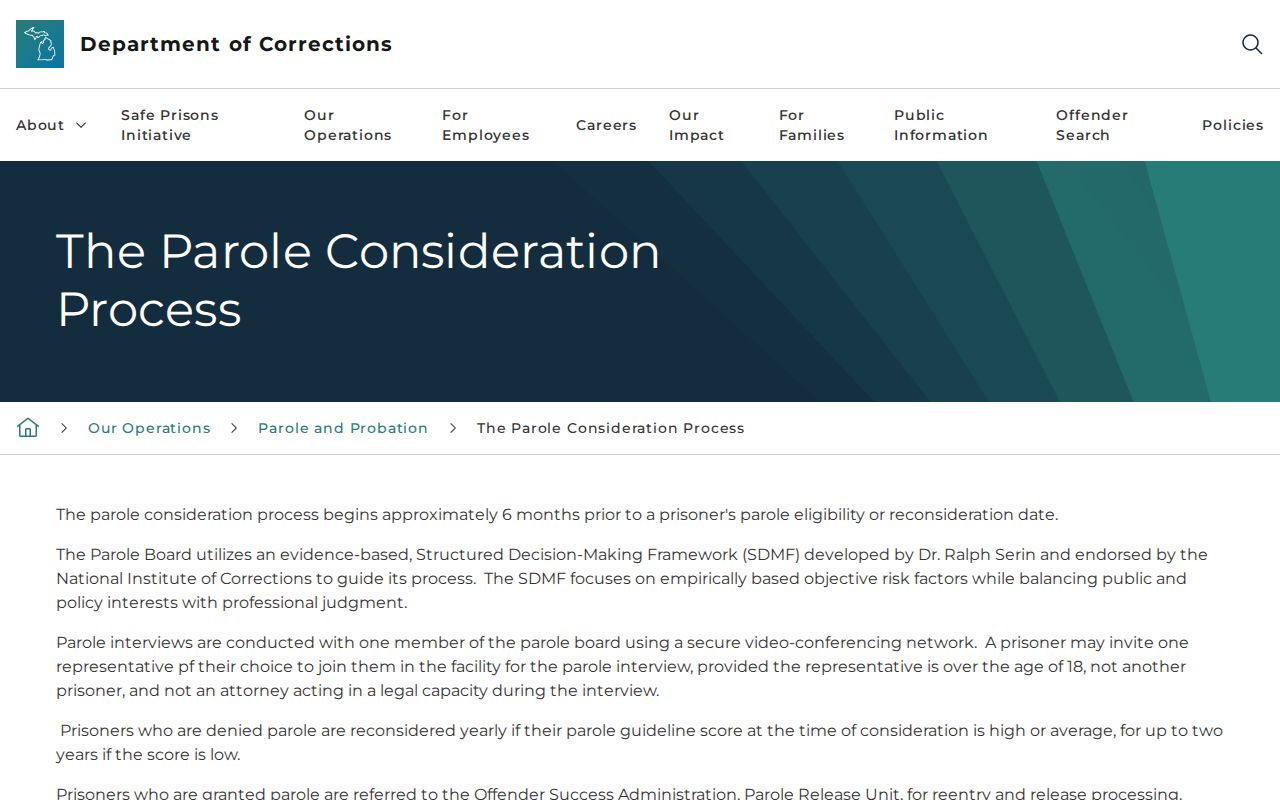
Read the sequence in order: minimum-term eligibility, Board action, proposed date, actual prison departure, parole supervision, then final discharge.
A non-personal example makes the distinction plain. A covered two-to-five-year term requires service of the full two-year minimum before Board jurisdiction. ERD does not open the gate. If parole is granted and the person later departs, OTIS may then show parolee or date-paroled information. The person remains under MDOC jurisdiction until discharge.
Confirm a Cass County Release
Confirmation should pair a planning record with an event record. For Cass County Jail, compare the court authority with the Sheriff’s actual release date, time, disposition, and destination. For state prison, compare the Board or sentence landmark with later OTIS parole or discharge data. A transfer ends custody at one facility but does not establish release to the community.
MI-VINE can provide a timely provider-fed alert for release, transfer, escape, bond release, or court-order discharge. Register while the person is still shown in custody, then read the precise event and reporting agency. The Cass County VINELink check explains the one-person search and notice process. VINE is not a certified release certificate, and a status update can lag the physical event.
When exact proof is needed, request the originating record. Ask the Sheriff for the Cass jail release entry, MDOC for the state record, or the federal custodian for a federal sentence. Do not turn one system’s “not in custody” result into a claim that every other jurisdiction has ended.
Note: Record the source, field label, and observation date so an eligibility date is never mistaken for the later release event.